
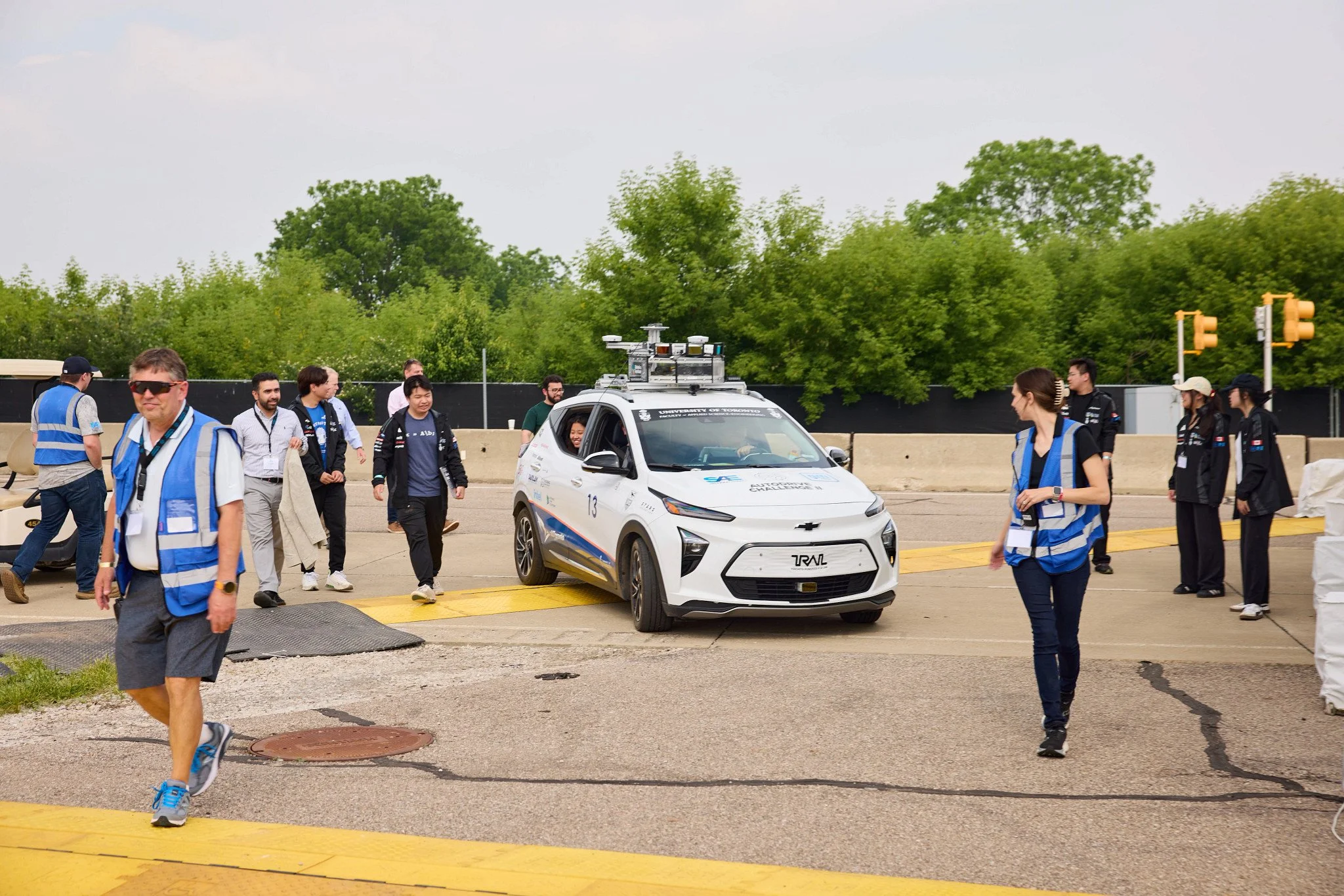
We’re Hiring for 2026-2027!
aUToronto is looking for passionate and talented individuals to join our team.
Fall recruitment will open in early September.


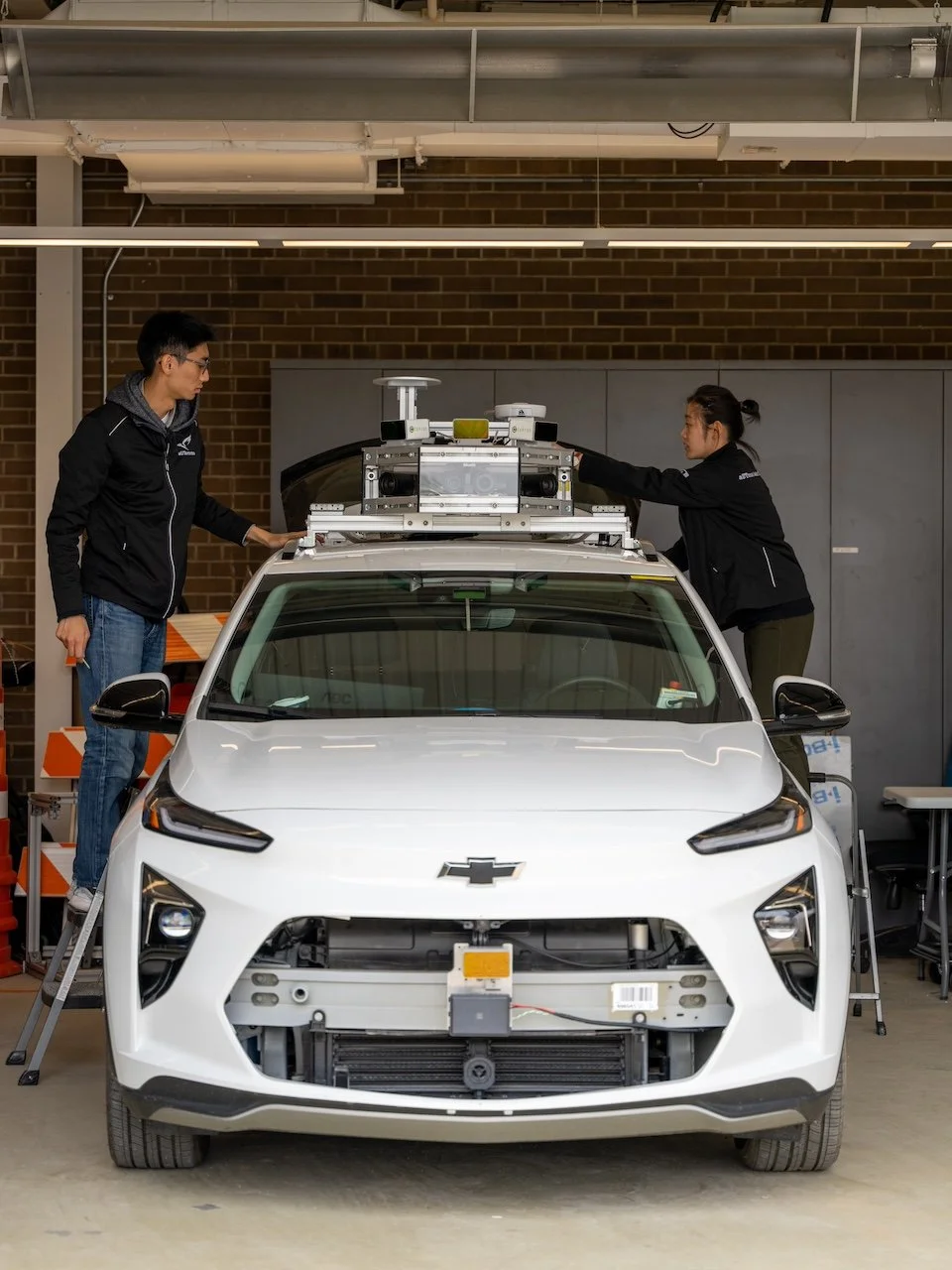


Open Team Positions
All application questions and materials are to be submitted through the Google Form, which you can access by clicking the “Apply Now” button above.
Before filling out the form, refer to the following list for all open roles. In the application form, there is an option for you to indicate other team(s) that you are interested in, so feel free to pick a couple that pique your interest!
Please direct all inquires related to recruitment to recruit@autodrive.utoronto.ca.
Systems
-
Responsible for developing procedures for calibration among and across cameras, LiDARs, RADARs, GNSS, and IMU. This includes both extrinsics, the pose of the sensors, and intrinsics, a model of the internal workings of each sensor.
Key Responsibilities
• Develop robust multi-sensor calibration procedures.
• Validate sensor calibration and identify when changes occur and re-calibration is required.
Skills
• Strong understanding of how various sensors operate and are modelled mathematically.
• Knowledge of state estimation techniques such as bundle adjustment.
-
Responsible for designing reliable systems to power sensors, compute, and accessories for the vehicle.
Key Responsibilities
• Designing and maintaining electrical systems on the vehicle (i.e. sensor power, BMS, lighting).
• Assembling PCBs and other electrical hardware.
• Working closely with other teams to ensure hardware compatibility when integrating new components and
assist in debugging any issues.
• Creating clear documentation for referencing.
Skills
• Experience with power electronics design and electrical wiring.
• Proficient with EDA tools (especially Altium/KiCAD).
• Strong proficiency at soldering and the ability to debug electrical issues.
• Ability to organize clear BoMs and other forms of documentation (e.g. order forms, common issues).
• Projects and experience with working with embedded systems and/or microcontrollers.
-
Responsible for the design of the interface the safety driver and passengers use to monitor the state of the autonomy software. This task is critical to ensuring a large amount of information is intuitive to understand with only a glance.
Key Responsibilities
• Designing mockups of various pages of our UI.
• Working with various teams and understanding their requirements.
• Responding to feedback to improve the utility and intuition of the UI design.
Skills
• Proficiency with design software such as Figma, Sketch, etc.
• Strong ability to communicate technical concepts and synthesize requirements.
-
Responsible for creating the primary interface with users of the vehicle. This task involves parsing lots of data from different sources into a single interface while ensuring low latency and responsiveness.
Key Responsibilities
• Managing the development of the user interface.
• Designing the software architecture such that the user interface can parse large amounts of data quickly.
Skills
• Experience with user interface development.
• Experience with a UI framework or game engine (React, Unreal Engine, etc.).
• Strong software development abilities, particularly in low-latency applications.
-
Responsible for automated and manual checks to ensure the vehicle software satisfies requirements. This includes code-level tests all the way to integration tests performed in simulated environments. Validation is a critical part of safe testing of our autonomous vehicle.
Key Responsibilities
• Manage the team's CI/CD infrastructure.
• Develop validation procedures to ensure the system behaves as expected.
• Work with teams to ensure all code is being tested properly.
Skills
• Experience with CI/CD pipelines.
• Strong software development abilities.
-
Responsible for creating tools that various sub-teams will use to create simulations and evaluate their results. These tools are critical to efficient software development across the team.
Key Responsibilities
• Work alongside many teams to understand their testing requirements.
• Develop and maintain tailored simulation solutions.
Skills
• Strong abilities to understand and implement feedback.
• Experience with user interface development.
Autonomy
-
Responsible for the software that finds a smooth trajectory for the vehicle that satisfies road rules, avoids obstacles, and is feasible to execute. As one of the last modules in the autonomous vehicle software, this code will ultimately determine where the vehicle moves.
Key Responsibilities
• Approximate the vehicle dynamics into simple models that can be evaluated efficiently.
• Design and implement algorithms that generate trajectory plans.
Skills
• Understanding of vehicle dynamics models and approximation methods.
• Knowledge of search algorithms.
• Strong software development abilities.
-
Responsible for the software that makes decisions about stop signs, traffic lights, and much more. They will work alongside the other leads to build a cohesive planning stack.
Key Responsibilities
• Build a complex and robust state machine.
• Conduct automated testing of various driving scenarios.
Skills
• Strong C++ programming skills.
• Ability to tackle highly complex engineering challenges.
• Experience with automated simulation tools.
-
Responsible for creating high fidelity 3D maps of environments based on driving data. This process involves
offline sensor fusion and state estimation such that large areas can be mapped accurately.
Key Responsibilities
• Building a mapping pipeline which produces 3D maps from sensor data.
• Removing dynamic objects from maps.
• Working alongside the semantic mapping team to provide sufficient information for labelling.
Skills
• Understanding of state estimation algorithms.
• Experience working with large datasets.
-
Responsible for augmenting the 3D maps with labels such as lane lines, curbs, traffic lights, etc. This involves creating a streamlined process for turning raw 3D data into information-rich maps that can be utilized across the autonomy software.
Key Responsibilities
• Creating an interface for labeling semantic information on 3D maps.
• Working closely with subteams to understand their requirements.
• Maintaining clear processes and guidelines to avoid errors and ambiguities in maps.
Skills
• Experience with user interface development.
• Ability to understand and communicate complex technical requirements.
Perception
-
Responsible for developing and evaluating the models that detect and classify lane lines, curbs, and traffic lights from camera images. These models are the key to extracting semantic information from the environment.
Key Responsibilities
• Leading lane/curb labelling efforts, including autolabelling.
• Training accurate detection and classification models.
• Validating model performance using test datasets.
Skills
• Strong understanding of deep neural networks.
• Experience with practical training techniques such as data augmentation.
• Ability to work with large datasets.
-
Responsible for building models that run directly on camera, LiDAR, and RADAR data to produce detections. These models typically exhibit higher performance at the expense of added complexity.
Key Responsibilities
• Researching SOTA detection models with an emphasis on real-time performance.
• Train models and deploy experiments to evaluate the performance compared to existing 2DOD and 3DOD models.
Skills
• Strong understanding of deep neural networks.
• Experience optimizing model performance.
-
Responsible for the software that processes multimodal detections into smoothed outputs. Tracking is a key step in the robotics pipeline, bridging the gap between raw detections and object information suitable for trajectory planning.
Key Responsibilities
• Create a robust tracker that can operate at high speeds.
• Understand and account for the nuances of various detection methods.
• Work alongside the planning team to satisfy object detection requirements.
Skills
• Understanding of state estimation algorithms.
• Experience with LiDAR, camera, and/or RADAR object detection.
• Strong C++ programming skills.
-
Responsible for creating models that predict the future behaviour of road users based on their history. Accurate prediction allows the vehicle to navigate safely in complex environments.
Key Responsibilities
• Explore and benchmark motion prediction algorithms.
• Understand and meet requirements such as latency and accuracy.
• Train and evaluate motion prediction models.
Skills
• Experience training and evaluating machine learning models.
• Strong understanding of deep neural networks.
• Experience optimizing model performance.
-
Responsible for developing and maintaining the infrastructure for data storage, data labelling, and model training.
Key Responsibilities
• Create and manage the infrastructure to house our internal datasets and train models.
• Work with perception teams to accommodate their data needs.
Skills
• Experience with large datasets and/or shared compute infrastructure.
• Understanding of data storage and compression concepts such as video encoding.
-
Responsible for optimizing machine learning models for the best performance on our vehicle. Both low latency and high throughput are crucial to safe autonomous driving.
Key Responsibilities
• Evaluate the performance of machine learning models.
• Work alongside perception teams to optimize model architecture.
• Compile models and manage the data pipeline to optimize performance.
Skills
• Experience with acceleration libraries such as TensorRT.
• Understanding of inter-process communication methods for large amounts of data.